Thursday, July 9, 2009

Toyota


Toyota Motor Corporation (Japanese: トヨタ自動車株式会社, Toyoda Jidōsha Kabushiki-gaisha?) (TYO: 7203) is a multinational corporation headquartered in Japan, and is currently the world's largest automaker.[4][5][6] Toyota employs approximately 316,000 people worldwide.
In 1934, while still a department of Toyota Industries, it created its first product Type A engine and in 1936 its first passenger car the Toyota AA. The company was eventually founded by Kiichiro Toyoda in 1937 as a spinoff from his father's company Toyota Industries to create automobiles. Toyota also owns and operates Lexus and Scion brands and has a majority shareholding stake in Daihatsu and Hino Motors, and minority shareholdings in Fuji Heavy Industries, Isuzu Motors, and Yamaha Motors. The company includes 522 subsidiaries.[7]
Toyota is headquartered in Toyota City and Nagoya (both in Aichi), and in Tokyo. In addition to manufacturing automobiles, Toyota provides financial services through its division Toyota Financial Services and also builds robots. Toyota Industries and Finance divisions form the bulk of the ToyName

Toyota headquarters in Toyota City, Japan
Vehicles were originally sold under the name "Toyoda" (トヨダ), from the family name of the company's founder,
Kiichiro Toyoda. In September 1936, the company ran a public competition to design a new logo. Out of 27,000 entries the winning entry was the three Japanese katakana letters for "Toyoda" in a circle. But Risaburo Toyoda, who had married into the family and was not born with that name, preferred "Toyota" (トヨタ) because it took eight brush strokes (a fortuitous number) to write in Japanese, was visually simpler (leaving off two ticks at the end) and with a voiceless consonant instead of a voiced one (voiced consonant is considered "murky" or "muddy" sound compared to the voiceless consonant, which is "clear"). Since "Toyoda" literally means "fertile rice paddies", changing the name also helped to distance the company from associations with old fashioned farming. The newly formed word was trademarked and the company was registered in August 1937 as the "Toyota Motor Company".[8][9][10]
In predominantly Chinese speaking countries using
traditional Chinese characters (eg Hong Kong, Taiwan), Toyota is known as '豊田'[11]. In predominantly Chinese speaking countries using simplified Chinese characters (eg China), Toyota is known as '丰田'[12] (pronounced as 'Fēngtián' in the Mandarin Chinese dialect). These are the same characters as the founding family's name "Toyoda" in Japanese, which translate to "fertile rice paddies" in the Chinese language as well.
From September 1947, Toyota's small-sized vehicles were sold under the name "Toyopet" (トヨペット).
[13] The first vehicle sold under this name was the Toyopet SA[14] but it also included vehicles such as the Toyopet SB light truck, Toyopet Stout light truck,[15] Toyopet Crown and the Toyopet Corona. However, when Toyota eventually entered the American market in 1957 with the Crown, the name was not well received due to connotations of Toys and pets.[16] The name was soon dropped for the American market but continued in other markets until the mid 1960's.ota Group, one of the largest conglomerates in the world.
On May 8, 2009, Toyota reported a record annual net loss of US$4.4 billion, making it the latest automobile maker to be severely affected by the 2007-2009 financial crisis.

Hyundai launched i20 diesel and automatic Hyundai i20

Hyundai Motor on Tuesday launched a diesel and an automatic variant of Hyundai i20 its premium compact hatchback, the i20. Hyundai i20 diesel will comes with a 1.4L CRDi 
engine with a maximum power of 90PS@4000rpm and a peak torque of 22.4kgm@1750~2750 rpm. ( Watch ) 

The i20 Automatic Transmission (AT) has a 1.4L GAMMA petrol engine. The engine uses a DOHC, 16 Valve, VTVT technology that ensures acceleration, smooth drivability, low emissions and optimum fuel mileage. The Automatic Transmission i20 uses a 4-speed gearbox with an overdrive lock switch. 

With the launch of the i20 Automatic, Hyundai became the first manufacturer to offer an automatic option across all the segments starting from the compact to the premium. 

The i20 offers 6 airbags, rear disc brakes with ABS and EBD which are standard equipment on the diesel and the automatic variant. 

Hyundai introduced the i20 at the Paris Motor Show in October 2008 with distinctive styling, refreshing features and unmatched safety features. The i20 since its launch in India on December 29, 2008 has sold over 72,000 units with domestic sales accounting for over 12,000 units while the export market covering different continents from Europe, Africa and Asia lapped up over 60,000 units. 

The i20 diesel and the petrol will be available in three different variants starting with Magna, Asta and the Asta Option which comes with a sunroof. The i20 Automatic will be sold in two variants namely the Asta and the Asta Option. The base Magna offers options like power windows, electric power steering with tilt and telescopic adjustment and air-conditioning/heating. The top-end Asta Option offers class leading premium features like six airbags, sunroof and alloy wheels. With the launch of the diesel and the Automatic variants the i20 is now available in eight variants and seven exciting colours.

The i20 diesel is priced between Rs 6.19-7.20 lakh, while the 1.4 petrol automatic is priced between Rs 7.31- 7.72 lakh.

i20 1.4 Magna Diesel with ABS            Rs619800
i20 1.4 Asta Diesel                                 Rs683431
i20 1.4 Asta (O) With Sunroof Diesel Rs720430
i20 1.4 Asta (AT)                                  Rs731130
i20 1.4 Asta AT (O) with sunroof       Rs772301

Wednesday, July 8, 2009

Saab


Originally known as Svenska Aeroplan Aktiebolaget (Svenska Aircraft Company), Saab is a Swedish company that began manufacturing automobiles in 1949. The company's early designs placed an emphasis on aerodynamics that is reflective of its history as an aircraft manufacturer. The first production Saab, the 92, boasted a lower coefficient of drag than many modern cars. The 93, unveiled in 1955, was powered by a three-cylinder, 33-horsepower engine, and featured the distinctive fastback profile that made early Saab cars among the most recognizable automobiles on the road. By the time the '50s drew to a close, Saab's lineup had grown to include the 95 wagon (capable of seating up to seven) and the 93 750 Gran Turismo, the automaker's first series-built sports car.The marque started the '60s with the introduction of its successful Saab 96. With a production run of 20 years, this was the car that made Saab a recognized presence in the international market. The decade also saw the launch of the Saab Sport coupe. Scoring numerous wins on the rally circuit, the coupe marked Saab as a force to be reckoned with. The Sport's success on the track inspired a name change; it later came to be known as the Saab Monte Carlo 850. The Saab Sonett II, with its body of fiberglass-reinforced plastic, also made its debut during the '60s, as did the Saab 99, which was the first to feature the manufacturer's trademark wraparound windshield.In 1973, Saab gave birth to the 99 Combi Coupe. The car came to be definitive of the Saab brand; with its hatchback and fold-down rear seat it offered remarkable utility. By the end of the decade, Saab had rolled out the 99 Turbo, which was a forerunner in harnessing turbo technology for use in production cars. The company also introduced the Saab 900, which held the distinction of being the first car to offer a cabin air filter.During the 1980s, Saab cars (especially the Turbo models) gained American popularity as young urban professionals (yuppies) sought them out. The decade saw the launch of the Saab 900 Turbo, the Saab 900 Turbo Aero (the world's first car to offer a 16-valve turbo engine) and a popular convertible version of the 900.In 1990, General Motors bought half of Saab's automotive division. The decade saw the launch of a revamped 900; the car offered a bevy of cutting-edge safety features, including three rear three-point seatbelts and rear side-impact protection. By the time the '90s drew to a close, Saab had also unveiled the 9-5, its first premium four-door sedan. The car offered a host of new technologies such as ventilated seats. It was also the first to offer Saab's Active Head Restraints, a system designed to prevent whiplash injuries.By the 2000s, General Motors had bought the other half of Saab Automobile. Despite the brand's position on the leading edge of safety technology, Saab's popularity in the U.S. has waned (however, the marque continues to be a big seller in Europe). Some have blamed the brand's poor performance domestically on GM's badge engineering of Saab cars. New models like the 9-2X and the 9-7X were based on platforms lifted from other GM brands — Subaru and Chevrolet, respectively. Still, many touches of individuality remain, and the brand has much to offer those who embrace its singular personality.

Nissan Altima Sedan


Nissan was born in Japan, and like other marques from its homeland, the brand is known for crafting vehicles that place an emphasis on edgy styling and performance. The company's lineup of vehicles is broad, and includes sporty coupes, family sedans, minivans, trucks and SUVs.The automaker got its start in 1933 as the Jidosha Seico Co., Ltd. The following year, this outfit merged with another Japanese manufacturer, and the new company was christened Nissan Motor Company, Ltd. Nissan initially marketed its vehicles under the Datsun brand, with the first Datsuns being built in 1934. Postwar, the brand made its presence felt worldwide, building a partnership with the U.K.-based Austin Motor Co. and establishing a presence in the United States. The first Datsuns hit American shores in 1958. Vehicles like the Datsun 1000 were based on Austin platforms.The '60s witnessed Nissan's merger with Prince Motor Company, a union that helped the Asian manufacturer create more luxury-focused vehicles. In the U.S. it began offering its first vehicle styled for the U.S. market, the Datsun 510 sedan. By the end of the decade, Datsun had exported more than 1 million vehicles. Datsun rose to prominence in the 1970s on the popularity of its 240Z sports car. Powered by an inline six-cylinder engine, the car was coveted for its blend of style, performance and affordability. By the time the '70s drew to a close, the automaker's cumulative vehicle exports had surpassed the 10 million mark.In 1981, Nissan shelved the Datsun name and began selling vehicles worldwide under the Nissan moniker. The '80s also saw Nissan's launch of a tuning division called Nismo for the development of performance-oriented vehicles and accessories. Nissan also brought its production to American shores, with the construction of a Tennessee-based plant.The early '90s saw Nissan's fortunes rise in the U.S. thanks to fun-to-drive cars like the 300ZX, Maxima and Sentra. But this trend didn't last long and by the late '90s Nissan's offerings consisted of anonymous vehicles. The company's future was uncertain.After the turn of the new century, however, Nissan bounced back. Its redesigned Sentra and Altima were well-received, as were new models like the Titan and Armada. A 1999 alliance with Renault, a European automaker, also helped to shore up the company's finances. Today the manufacturer is known for offering a wide range of vehicles capable of going head to head with the best of the best when it comes to overall quality, dependability and performance.

Tuesday, July 7, 2009

Corolla RunX


The Corolla is a line of subcompact/compact cars produced by the Japanese automaker Toyota, which has become very popular throughout the world since the nameplate was first introduced in 1966. In 1997, the Corolla became the best selling nameplate in the world, with over 35 million sold as of 2007.[1] Over the past 40 years, one Corolla car has been sold on average every 40 seconds.[2] The series has undergone several major redesigns.
The name Corolla is part of Toyota's naming tradition of using the name Crown for primary models: the Corona, for example, gets its name from the Latin for crown; Corolla is Latin for small crown; and Camry is an Anglicized pronunciation of the Japanese for crown, kanmuri.
Corollas are manufactured in Japan and in Brazil (Indaiatuba, São Paulo), Canada (Cambridge, Ontario), China (Tianjin), India, Indonesia, Malaysia, Pakistan, Philippines, South Africa, Taiwan, Thailand, Turkey, the United Kingdom (Derbyshire), the United States (Freemont, California) and Venezuela.
The Corolla's chassis designation code is "E", as described in Toyota's chassis and engine codes.

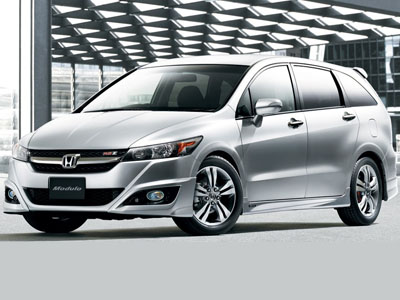
Honda has presented tuning package Modulo for Stream

Honda Stream

After some days after the beginning of sales in Japan restyling the version the minivein and updatings of firm tuning packages from Mugen, on the market leaves version Modulo.

Honda Stream by Modulo

Car Honda Stream from Modulo, presented Honda Motor under brand Modulo, is changed only as regards appearance, unlike other tuning brand — Mugen, known first of all by perfection of a technical component. The structure of package Modulo includes the modified bumpers, overlays on thresholds and a small spoiler on the fifth door. The tuning system of release becomes unique addition influencing car dynamic characteristics: however, the system is not included into obligatory structure of a package. In car salon on former without changes.

The forward optics of the car remained without changes, and back can be replaced at will: new lanterns on the basis of light-emitting diodes are provided. Cost of tuning package Modulo for Honda Stream is not called. The car is calculated on installation in the sports version RS-Z differing from standard absence of two places for passengers in a back part of salon, but can be completed and in base complete set Honda Stream.

2009 Honda Stream

Related Posts: Honda

2009 Mercedes-Benz SLK-Class Styles


Introduction:
Mercedes-Benz's three-pointed star has long been synonymous with style and prestige, but it has historically taken a backseat to BMW's blue and white propeller as a symbol of driving excitement. This was certainly true of the first-generation SLK roadster, which offered decent straight-line speed and a then-novel folding hardtop but lost points due to its archaic recirculating-ball steering design and generally less-than-sporting demeanor. But when the folks at Mercedes set about redesigning the SLK a few years ago, they had evidently grown tired of playing second fiddle to their Bavarian rival in the minds of discerning drivers. That's the only way to explain the downright frisky performance of the 2009 Mercedes-Benz SLK-Class roadsterBody Styles, Trim Levels, and Options
The 2009 Mercedes-Benz SLK-Class is a luxury roadster equipped with a power-retractable hardtop. Three trim levels are offered: SLK300, SLK350 and SLK55 AMG. Standard equipment on the SLK300 includes 17-inch alloy wheels (up an inch from last year), leather upholstery, a tilt/telescoping steering wheel, dual-zone automatic climate control and a prPowertrains and Performance:
Under the SLK300's hood is a 3.0-liter V6 that makes 228 hp and 221 lb-ft of torque. The SLK350 packs a 3.5-liter V6 good for 300 hp and 265 lb-ft of torque. The SLK300 can be had with either a six-speed manual or a seven-speed automatic transmission with manual shift control, while the SLK350 is only available with the same seven-speed auto. The high-performance SLK55 AMG comes with a beastly 5.4-liter V8 that cranks out 355 hp and 376 lb-ft of torque; a seven-speed automatic is mandatory. While the AMG is a world-class performer, with a 0-60-mph time in the neighborhood of 5 seconds, even the base SLK300 provides sprightly acceleration, especially with the standard six-speed manual shifter. Thanks to its engine refinements for '09, the SLK350 should chop a few tenths off the 6.3-second time we measured for last year's SLK350.emium audio system with a 5-inch LCD screen and an in-dash six-CD changer. The SLK350 adds a larger V6 engine and upgraded brakes. The gonzo V8-powered SLK55 AMG affords rocket-like acceleration and includes 18-inch wheels, high-performance tires, even larger brakes, a sport-tuned suspension, power heated sport seats with driver-side memory, upgraded leather upholstery, a power tilt/telescoping steering wheel and unique interior and exterior trim details.
Some of the AMG model's standard features are available as options on lesser models. Also optional are bi-xenon headlamps, an iPod integration kit, satellite radio, a navigation system with an expanded 6.5-inch LCD screen, a Harman Kardon surround-sound audio system and an Airscarf system that directs heat through vents in the head restraints. For non-AMG models, a "Sport Package" adds 18-inch AMG wheels, a sport-tuned suspension, steering-wheel-mounted shift paddles and a few exterior styling enhancements.


Driving Impression:


Forget those stolid Mercedes convertibles of decades past -- the 2009 Mercedes-Benz SLK-Class will put a smile on any driving enthusiast's face, while remaining comfortable and compliant enough to appeal to the average driver. The purpose-built AMG model is harder-edged, of course, but the SLK300 and SLK350 offer an alluring combination of comfort and handling prowess. Only in direct comparison with pure performance cars like the Boxster do the SLK's relatively uncommunicative steering and less tossable nature become apparent.