Tuesday, July 7, 2009

Suzuki Grand Vitara


The third-generation Grand Vitara is a pure SUV (sport utility vehicle) born and bred to free the spirit and open paths where none existed before. Under a product concept of "off-road athlete", it then exactingly engineered the model in the same way athletes rigorously train to excel in a wide range of demanding situations. The goal was straightforward: Improve on the real all-road mastery, efficient performance, practical urbanity, and the ease of use people have come to associate with the Grand Vitara. Suzuki's heritage of producing sporty 4X4 vehicles with real off-road capabilities provided the DNA; advanced automotive engineering, the breeding.
Design and equipment levels anticipate new expectations, while technological advances raise convenience and versatility for all. Furthermore, two model configurations allow consumers to choose the model right for them. The 5-door is directed at families, outdoor enthusiasts, and others looking to maximize utility and versatility while 3-door is aimed at customers wanting nimble agility and efficiency. Whichever the configuration, the Grand Vitara is not for people afraid to live beyond conventions: It's for people who know the real journey begins where the road ends.

BMW 2009 Series 7


Gallery: 2009 BMW 7 Series


Click any image to enlargeWe went over the car's outward appearance in our preview post. The new car is certainly more restrained than the last iteration, but reader feedback has shown that its style still polarizes. This is unsurprising, and ultimately, it's probably good for BMW because either way, you have people speaking passionately about your car. Besides, the people whose opinions matter most are the ones in dealerships, holding checkbooks, and there likely won't be a shortage of those folks when these cars roll into showrooms, anyway.Inside, there are a number of improvements. First, the shifter moves back to the console from the steering column. The unit itself is the same silver lever you'll find in a 5-series. To its right is the new iDrive controller, which steals a page from Audi's MMI and combines the main stick/dial with action buttons that ought to streamline the process of navigating through all the menus. The menus themselves have also been redesigned, and in a welcome move, the climate controls can be fully adjusted right from the instrument panel -- iDrive is no longer required to make some adjustments at all. The actual iDrive screen is now over 10 inches wide. Other neat-sounding interior changes we're interested in seeing in person include the new Black Panel display for the IP. Basically, only the gauge rings and needles are visible when the car is shut off. The other details only reveal themselves once it has been fired up. Backseaters get a pair of video screens, and each passenger has control over what his or hers displays. The camera package incorporates both rearview and sideview cameras. The latter uses a camera mounted in each corner of the front bumper to give a clear look down an intersecting road in both directions. (This sounds like an improved version of the setup BMW uses in the Rolls-Royce Phantom, which puts both cameras in a single protrusion in the middle of the front bumper). Active steering is optional, lane departure and blind spot warning systems arrive with the new car, and the Euro versions get a brake regeneration system like the one found in the European M3. (As is the case with the M3, it doesn't appear that this feature makes the trip across the Atlantic in the 7.) You can read about all the changes and features in greater detail below, where we've pasted the UK-market press release. If you want a sneak peek of the U.S. press release, head to AutoSpies, which has posted it in PDF format. (We'll append it on Sunday when BMWNA officially uploads it to its media site). ***

Click above for a high-res gallery of the new 7 SeriesBMW has officially announced the details pertaining to the 5th generation 7 Series, so let's cut right to the chase. In Europe, there are five models arriving on the market in November of this year: the 730d; the 740i and Li; and the 750i and Li. The latter two are powered by the same twin-turbo 4.4L V8 that debuted in the X6. In the U.S.-market 7 Series, the turbo eight is rated at 400 horsepower and 450 lb-ft of torque, and it is the sole engine option being made available. If you want a BMW 7 Series in America, it will be a 750. Europeans get more choices. The 730d's 3.0L diesel I6 pumps out 245 horses with nearly 400 lb-ft of torque. Despite the grunt, it boasts a combined fuel economy number of 32.6 U.S. miles per gallon (39.2 Imperial). The 740 models are powered by the now-familiar 3.0L twin-turbo gasoline engine. In the 7, the 3.0TT's power output is 326 horses and 332 lb-ft -- enough to hustle the 740Li from 0 to 62 mph in six seconds flat. All the engines are connected to a six-speed automatic. Follow the jump for more details and BMW's official press release.

Welcome to Ultra Luxury Car


Ultra Luxury Sports Cars
These cars are often slightly lower on the luxury scale but higher on the performance end. The largest qualifications for being an ultra luxury sports car involve acceleration from 0-60 mp/h (about 0-100 km/h) and top speed. The acceleration should be 3.8 sec. at the highest, and a top speed of over 225 mp/h (over 360 km/h). Some ultra luxury cars excell in this category in that they have unbeatable performance and in the next category as well.
Ultra Luxury Touring Cars
This type of ultra luxury car is much more luxurious than the sports cars and usually not as high on the performance end, although some are still capable of going at high speeds. The key with these cars is refinement. Leather, wood, or Alcantara are standard features in ultra luxury touring cars. Although many of these cars have high performance compared to normal cars, they are usually not as powerful or fast as the sports cars. For those who demand luxury and refinement, only an ultra luxury touring car will do.
Ultra Luxury Image GalleryMake sure to stop by our image gallery to find high quality pictures of the amazing cars you have seen here. We make it our duty to provide the viewer with many diverse pictures that allow them to see the car of their dreams from an many different angles as possible.

Monday, July 6, 2009

2006 Mazda MX-5 Miata


Weight is not good for sports cars as it hurts acceleration throttle response, handling and agility. It affects braking distances and fuel economy. That’s why Mazda engineers worked hard to reduce weight while building a roomier and safer car.

To save weight designers had to aluminum for the hood and trunk lid along with suspension and braking components. These is widespread use of high-strength and ultra high-strength steel in the unitary construction body that boosts body strength while simultaneously cutting weight. The new 2.0-liter engine features an aluminum block and head and the intake manifold and cam cover are made from lightweight composite plastic. Finally, overall weight has increased by just 27 lbs over the second-generation car and yet the car is roomier for tall or large adults and safer thanks to its stronger body and improved safety features.

By utilizing the “gram strategy” Mazda achieved a vehicle that is roomier and safer. This means that every gram was made by assessing the weight of the vehicle in the smallest possible increments. Under this “gram strategy”, the design of the rear-view mirror was simplified, thus trimming 84 grams, or 0.19 lbs. By applying this strategy throughout every nook and cranny of the MX-5’s design, Mazda engineers were quite effective in building a light, roomier, stronger and safer sports car.

Another imperative was to improve bending rigidity by 22% and torsional rigidity by 47%. They achieved it by using high-strength and ultra-high strength steelin the construction of the body-in-white. In addition, the rear of the transmission is rigidity linked to the front of the differential housing by a Z-shaped frame made of aluminum. This assures that the driver’s throttle inputs are faithfully and promptly conveyed to the rear wheels, ensuring the maximum possible oneness between car and driver.

2009 Mercedes SL65 AMG Black Series

Mercedes finally revealed the 2009 SL65 AMG Black Series, a model limited to only 200 units for the US market, each priced at $320,000.

The new SL65 AMG Black Series coupe features a carbon-fiber fixed roof, front fenders, hood, trunk lid and front and rear aprons. With all these super-strong, lightweight parts, plus the absence of retractable roof hardware, the car is more than 550 pounds lighter than the standard SL.

Under the hood AMG placed a modified version of the 6.0-liter AMG V12 engine that now delivers 650 horsepower and a staggering 738 pound-feet of torque. Its twin turbochargers are 12 percent larger, passages for intake air and the turbo wastegates have been modified, and the intake air intercooler is 30 percent more efficient. The result is zero-to-60 mph acceleration of only 3.8 seconds, and an electronically limited top speed of 198 mph.

Press release after the jump.

Wednesday, July 1, 2009

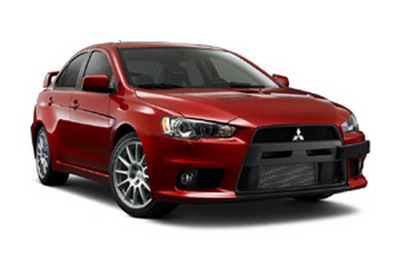
New Mitsubishi Lancer Evolution FQ-330 SST

Lancer Evolution

Company Mitsubishi has presented on the British market the high-speed version of the tenth generation of model Lancer Evolution — FQ-330 SST.

2010 Mitsubishi Lancer Evolution

Power of the modernised 2-litre 295-strong engine have increased to 329HP the maximum twisting moment — 437Nm. The car equip with six-step transmission Sports Shift Transmission. Dispersal to 100 km/h for 4,4 sec — for 0,3 sec faster than Mitsubishi Lancer Evolution FQ-300 SST. The maximum speed — 250 km/h.

Cost of Mitsubishi Lancer Evolution FQ-330 SST makes 35,900 pounds.

Mitsubishi Lancer Evolution X FQ-300 SST

Related Posts: Mitsubishi Lancer